Live roulette brings a physical roulette wheel, a real croupier and a streamed casino studio together with a digital betting layout. The essential choices are less glamorous than the camera angle: which wheel is in use, what the rules pay, whether the table is suitable for your budget and whether the gambling activity is authorised where you are.
For South African residents, legality comes first. The National Gambling Board (NGB) (https://www.ngb.org.za/latest-news/national-gambling-board-welcomes-the-supreme-court-of-appeal-ruling-on-the-bookmakers-offering-roulette-games-and-casino-games/) states that interactive online casino gambling is not permitted under the National Gambling Act. A bookmaker licence, a local payment method or a .co.za address does not by itself authorise online live roulette. Roulette at a properly licensed, land-based casino is a different regulatory setting.
What is live roulette?
Live dealer roulette is a live casino table game built around an actual spinning wheel and ball. A trained dealer, or croupier, manages the round from a casino floor or a dedicated live casino studio. The action is transmitted through an HD video feed, while a betting interface lets participants select numbers, colours and groups of numbers before betting closes.
The video stream and the betting system perform different jobs. Cameras show the wheel and dealer; the betting grid records wagers and calculates potential payouts; and game-control technology records the winning pocket. Some studios use optical character recognition (OCR) and other sensors to support result capture and bet settlement. The visible outcome still comes from the physical wheel in a conventional dealer-led game.
Live roulette is not the same as RNG roulette. In a standard online roulette game, a random number generator (RNG) produces the outcome without a live physical spin. Auto Roulette may use a real automated wheel but no croupier, while First Person Roulette generally uses a computer-generated presentation. The label “live” is therefore worth checking against the actual game description, not just the thumbnail.
Roulette also differs from live blackjack, live baccarat and live poker, where decisions or card handling shape the experience. Live casino game shows such as Crazy Time, MONOPOLY Live, Dream Catcher and Deal or No Deal Live can have wheels and bonus rounds, but their rules are not standard roulette rules.
How a live roulette round works
- Check the table details. Identify the roulette variant, single-zero or double-zero wheel, minimum bet, maximum bet and any special payout conditions.
- Choose chips and place bets. The roulette layout accepts inside bets on particular numbers and outside bets on larger groups. Multiple chips can cover different outcomes in one spin.
- Watch the betting window. A countdown timer shows when the wagering period is ending. The dealer announces “no more bets”, and the interface closes further changes.
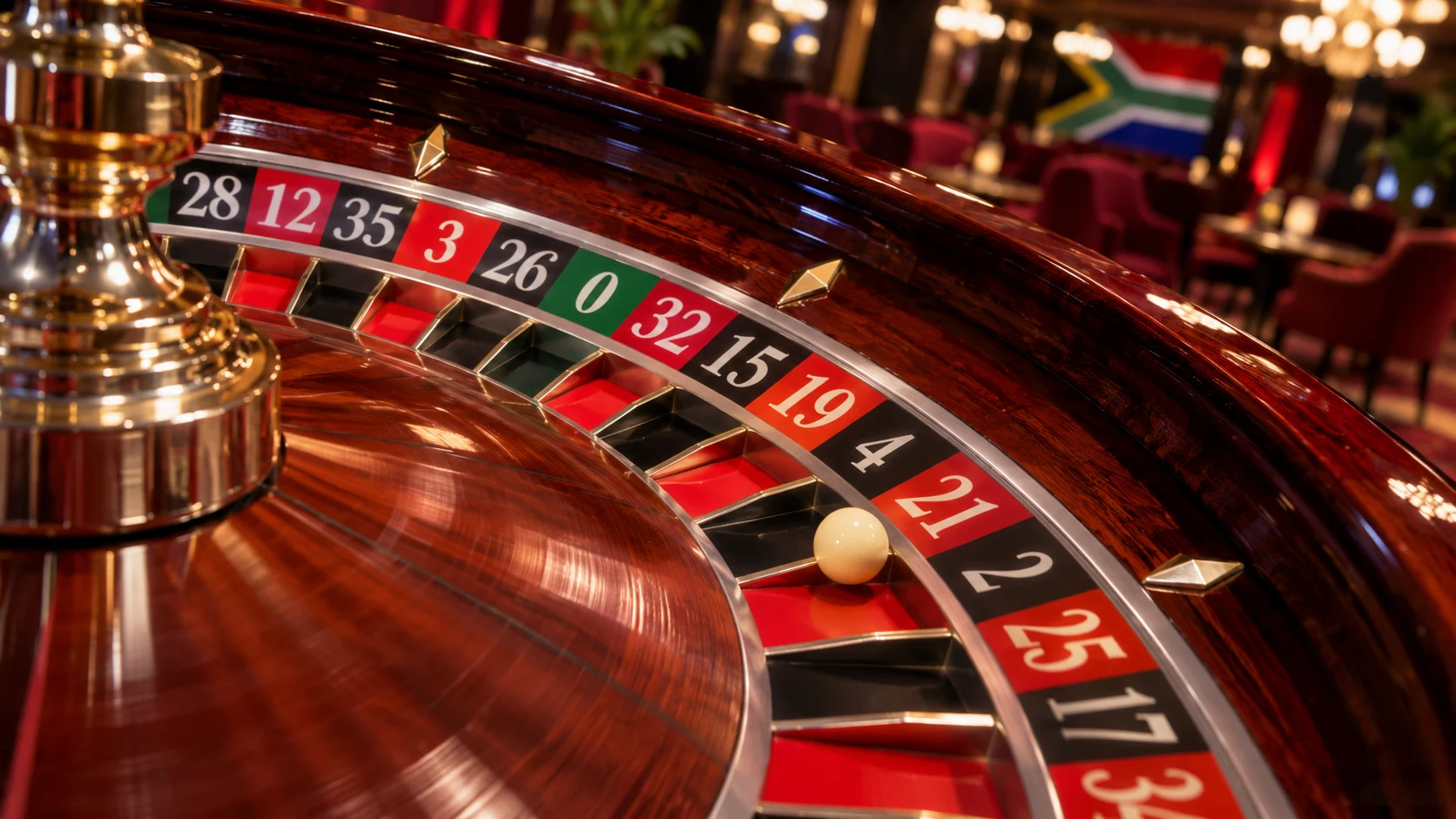
- Follow the spin. The roulette ball moves around the wheel and settles into one numbered pocket. The dealer identifies the winning number and colour.
- Review settlement. Winning bets are credited under the paytable, losing stakes are deducted and the game history records the round. The next betting window then opens.
Live chat can make the session feel more social, but it does not influence the ball or the odds. Features such as Rebet, Double and favourite bet layouts reduce the number of taps required; they can also repeat or increase a stake before you have reconsidered its size. A fast table is not automatically a better table, especially when the shortened decision window encourages rushed bets.
European, French and American live roulette compared
The wheel format has a direct mathematical effect. European and French roulette use 37 pockets, numbered 0 to 36; American roulette has 38 pockets because it adds 00. Both green zero pockets lose for ordinary red/black and odd/even bets.
| Variant | Wheel | Standard house edge | The deciding detail |
|---|---|---|---|
| European Roulette | 37 pockets; single zero | 2.70% (97.30% theoretical RTP) | Baseline single-zero rules |
| French Roulette | 37 pockets; single zero | 2.70% normally; 1.35% on qualifying even-money bets with La Partage | Check whether La Partage or En Prison actually applies |
| American Roulette | 38 pockets; zero and double zero | 5.26% (94.74% theoretical RTP) | The extra green pocket raises the advantage to the house |
French roulette may apply La Partage, returning half the stake on an even-money bet when the result is zero. Some tables instead offer En Prison, which holds the qualifying stake for a further spin under specific rules. Under the usual assumptions, these rules reduce the house edge on those particular even-money wagers to about 1.35%. They do not give every French roulette bet a 98.65% return. Read the actual rules before assuming either feature exists.
Specialist live roulette formats
Speed Roulette shortens the time between spins, while Auto Roulette relies on an automated physical wheel. Immersive Roulette emphasises slow-motion replays and multi-camera views. VIP Roulette and Salon Privé Roulette typically focus on a premium studio presentation or higher table limits; neither label promises better odds.
Lightning Roulette and XXXtreme Lightning Roulette add random multipliers or other special mechanics to selected outcomes. Double Ball Roulette uses two balls and needs its own paytable. Titles such as Quantum Roulette, Mega Fire Blaze Roulette, First Person Lightning Roulette, Red Door Roulette, Instant Roulette, Mini Roulette and Multi-Wheel Roulette may appear in international game catalogues, but their exact mechanics, RTP and availability are game-specific. A title appearing in a comparison list does not establish that it can legally be offered to a South African player.
When choosing between variants for mathematical clarity, the single-zero wheel is easier to evaluate than a heavily modified multiplier game. Speed, studio production and animated effects change presentation; special multipliers and side bets can change the underlying paytable and volatility.
Live roulette bets, payouts and winning chances
Inside bets cover one to six specific numbers. Outside bets cover larger sets such as red or black, odd or even, high (19 - 36) or low (1 - 18), dozens and columns. Higher winning frequency comes with a smaller payout; it does not remove the house edge.
| Bet | Numbers covered | Net payout | Chance of winning |
|---|---|---|---|
| Straight-up bet | 1 | 35:1 | 1/37 = 2.70% |
| Split bet | 2 | 17:1 | 2/37 = 5.41% |
| Street bet | 3 | 11:1 | 3/37 = 8.11% |
| Corner bet | 4 | 8:1 | 4/37 = 10.81% |
| Six-line (double street) | 6 | 5:1 | 6/37 = 16.22% |
| Dozen or column | 12 | 2:1 | 12/37 = 32.43% |
| Red/black, odd/even, high/low | 18 | 1:1 | 18/37 = 48.65% |
A payout of 35:1 describes profit, not the entire amount returned. A winning R10 straight-up wager earns R350 profit and returns the original R10 stake, producing R360 in total. A winning R50 red bet earns R50 profit, giving a total return of R100. If several bets were placed in the same round, deduct all stakes to calculate the actual net result.
Some layouts include trio bets near zero or special basket and top-line combinations; their coverage and payouts depend on whether the wheel is European or American. A French-style racetrack can also simplify call bets such as Voisins du Zéro, Tiers du Cylindre and Orphelins, which select groups of physically neighbouring wheel pockets rather than adjacent cells on the number grid. A neighbours bet is a grouped chip placement, not a new category of probability.
For the standard rules and betting terminology, see the MGM GameSense roulette rules (https://www.mgmresorts.com/en/gamesense/guide-to-roulette.html). Individual games can differ, especially multiplier formats.
RTP, house edge and the cost of repeated spins
Return to player (RTP) is the theoretical proportion of stakes paid back over a very large number of rounds; it is not a promise about one session. House edge describes the mathematical advantage built into the game. For standard European roulette, the 2.70% edge corresponds to roughly 97.30% theoretical RTP. For standard American roulette, the edge rises to about 5.26%, leaving 94.74% theoretical RTP.
Consider a R50 red bet on European roulette. There are 18 red pockets, 18 black pockets and one green zero. The chance of winning is 18/37, approximately 48.65%, not 50%. With a 1:1 payout, the expected loss is R1.35 per R50 staked over many such bets. On a standard American wheel, the chance is 18/38, approximately 47.37%, and the expected loss is about R2.63 per R50. These are mathematical averages, not predictions of an individual spin.
The same underlying single-zero edge applies to standard straight-up, split, street, corner, six-line, dozen and column bets. More covered numbers increase how often a wager wins but reduce its payout. A multiplier roulette game may redistribute payouts or alter its RTP; the standard 97.30% figure should never be copied onto a special-format title without checking its own rules.
Roulette also has short-term variance: a session can produce a profit despite a negative expected value, or a loss much larger than the theoretical average. Two or three wins do not change the next spin. A table's game history and “hot and cold numbers” display past outcomes, not a reliable forecast of the next winning pocket.
Live roulette studios and software providers
International live casino catalogues commonly associate roulette with providers such as Evolution Gaming, Pragmatic Play Live, Ezugi and Playtech Live. Other names appearing in live gaming discussions include BetGames, On Air Entertainment, Authentic Gaming, Vivo Gaming and Live88. A studio provider supplies game technology and presentation; it is not automatically the entity licensed to accept a player's wager in South Africa.
Provider branding can help identify whether a title uses a real dealer, an automated wheel, a proprietary multiplier mechanic or a particular camera setup. It cannot establish the legal status of the operator displaying that game. Likewise, a certificate or offshore licence in another jurisdiction does not substitute for permission under South African law.
Before comparing tables, check the game-specific rules screen for the pocket count, published theoretical RTP, stake range, unusual bets and procedures for cancelled or interrupted rounds. Studio quality matters for usability, but a visually convincing live stream is not itself evidence of regulatory compliance or fair settlement.
Mobile live roulette, rand pricing and connection issues
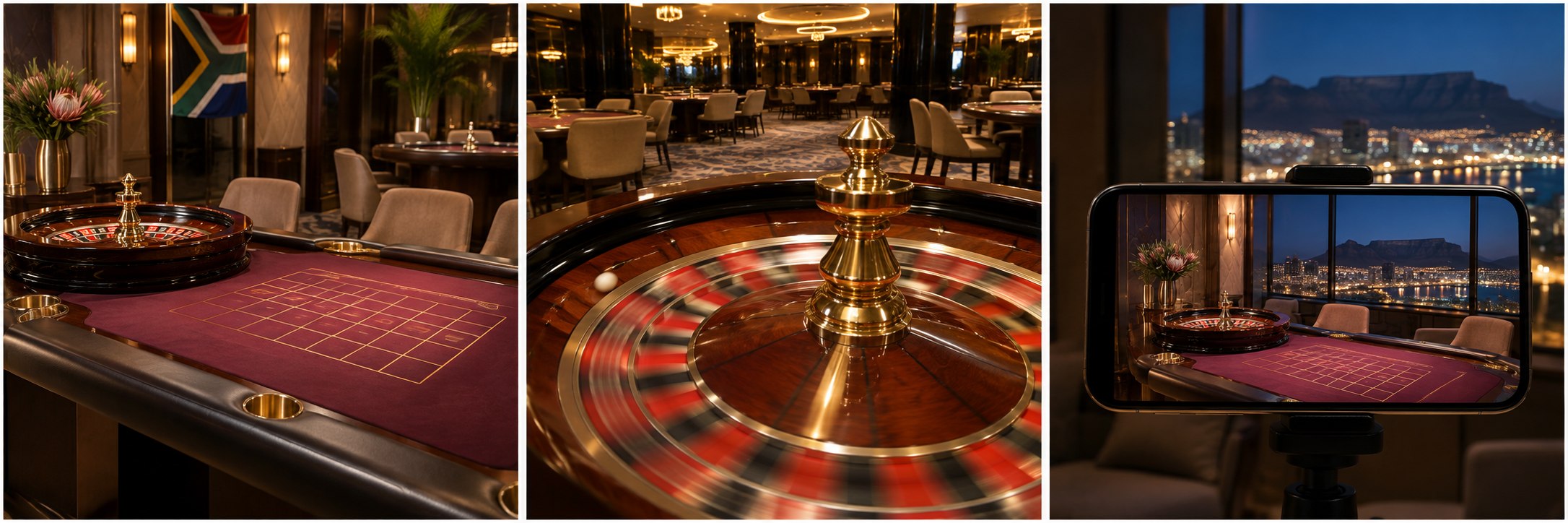
Live roulette interfaces are often designed for Android and iOS phones as well as desktop browsers. Portrait and landscape layouts can differ: the video may shrink when the betting grid is expanded, while chip controls or the roulette racetrack may occupy a separate panel. A stable Wi-Fi or 4G connection helps a live feed remain usable, but network stability does not lengthen the betting window.
A participant viewing a remote studio from Johannesburg, Cape Town or Durban may see a scheduled session in South Africa Standard Time (SAST), or a different time zone set by the platform. An advertised 24-hour international lobby does not imply lawful access from South Africa. Video quality and session length affect mobile data usage; test a non-wagering preview if offered and consider data costs before opening a stream.
Rand amounts deserve attention even when a site displays a ZAR balance. A minimum bet can mean the total minimum for the round or a minimum per chip or bet position; check the table rules. Maximum bets, VIP limits and currency conversion may also differ. Displaying South African rand does not prove local gambling authorisation.
Payment names such as electronic funds transfer (EFT), Instant EFT, Ozow, Capitec Pay, 1Voucher, Blu Voucher, Visa and Mastercard are sometimes listed alongside gambling offers. Their presence is not proof that a roulette product is legal or that funds are recoverable. Where a financial account is legitimately required, know-your-customer (KYC) and Financial Intelligence Centre Act (FICA) checks can affect verification and withdrawals. Never confuse a quick deposit with guaranteed cash-out speed.
Promotions require the same scrutiny. A welcome bonus, cashback offer or free spins promotion may exclude roulette entirely or apply a reduced contribution towards wagering requirements. A bonus headline does not change the wheel's house edge. Free-play or demo roulette without a cash stake can be useful for learning betting positions, provided the product genuinely involves no wager or cash-equivalent reward.
Is online live roulette legal in South Africa?
Do not assume it is. The National Gambling Board's published position is that interactive gambling is not permitted under section 11 of the National Gambling Act 7 of 2004, while properly licensed online fixed-odds sports betting operates under a different regulatory framework. The NGB reiterated this distinction in its statement of 29 October 2025 following litigation over roulette bets offered by bookmakers.
On 21 October 2025, the Supreme Court of Appeal of South Africa decided Portapa (Pty) Limited t/a Supabets and Others v Casino Association of South Africa, reported as [2025] ZASCA 158. Applying the Gauteng Gambling Act 4 of 1995, the court declared that bookmakers in Gauteng could not offer fixed-odds bets on casino games, including roulette, under their bookmaker licences. The decision concerned the boundary between bookmaker activities and casino gaming, not a finding that roulette is a sporting event.
The judgment's reach beyond Gauteng has been debated. The NGB regards the ruling as reinforcing the nationwide restriction on interactive gambling. The South African Bookmakers' Association (SABA) argues that the court's specific declaration under Gauteng legislation should not automatically be extended to all provincial bookmaker regimes. Those are distinct positions: the court's Gauteng order should not be described as a province-by-province judgment about every bookmaker, and an industry association's interpretation should not be treated as regulatory permission.
The useful distinction is between a bookmaker licence, a casino licence and an offshore licence. Each concerns different activities and jurisdictions. Provincial licensing authorities, including bodies such as the Gauteng Gambling Board and Western Cape Gambling and Racing Board, regulate operators within their statutory mandates. A site listing Betway South Africa, Hollywoodbets, 10bet South Africa, Sportingbet South Africa, SunBet or YesPlay in a live casino comparison does not establish that any named business is currently authorised to offer interactive live roulette. Operator status and permission for the specific product require separate verification.
For an in-person roulette experience, check the licence of a land-based casino and the conditions applying to that premises. Do not rely on search rankings, promotional banners or a foreign gaming certificate as a substitute for an applicable South African authorisation.
Primary legal references: Supreme Court of Appeal judgment [2025] ZASCA 158 (https://www3.saflii.org/za/cases/ZASCA/2025/158.html); NGB statement, 29 October 2025 (https://www.ngb.org.za/latest-news/national-gambling-board-welcomes-the-supreme-court-of-appeal-ruling-on-the-bookmakers-offering-roulette-games-and-casino-games/); SABA response, 31 October 2025 (https://www.bookies.co.za/media-statement-sca-judgement-and-online-betting/).
What to check before trusting a live roulette table
| Question | What to verify | When to reject the claim |
|---|---|---|
| Is the product lawfully offered - | The relevant South African authorisation for that gambling activity, not merely the operator's name | Only an offshore licence, bookmaker logo or generic “licensed casino” badge is shown |
| Which wheel is used - | Single zero, double zero or a modified game with its own rules | The wheel format or paytable cannot be found |
| What does one spin cost - | Total chips committed, table minimum/maximum and any currency conversions | “Double” or Rebet can silently exceed the intended stake |
| How are disputes handled - | Game history, round identifier, interruption policy and named support channel | There is no way to identify a disputed spin |
| Do promotions apply - | Roulette eligibility, wagering requirements and withdrawal conditions | A bonus claims guaranteed profit or hides material conditions |
This sequence matters more than a “best live roulette casino” ranking. A table that fails the authorisation check is unsuitable regardless of its stream quality, apparent payout rate or payment convenience.
Roulette strategies, bankroll limits and responsible gambling
Martingale, Fibonacci, Labouchere and D'Alembert are betting progression systems, not ways to change probability. Martingale, for example, increases stakes after losses in an attempt to recover them with a later win. A run of losses can rapidly exhaust a bankroll or reach the table limit. Flat betting keeps stake size more predictable, but still leaves the house edge intact.
Each standard spin is editorial. The belief that red is “due” after many black results is the gambler's fallacy. Neither recent results, wheel history nor a sequence of lucky numbers creates a reliable advantage. Claims of exploitable wheel bias need exceptional physical evidence and do not describe ordinary live casino play.
For adults aged 18 and over in a lawful gambling setting, treat stakes as an entertainment cost, decide a maximum affordable loss and a session time limit in advance, and stop when either limit is reached. A loss limit, deposit limit or self-exclusion facility may offer additional control; chasing losses is a warning sign, not a recovery plan. Gambling should never be used to cover household expenses or debts.
The National Responsible Gambling Programme offers free, confidential support. Find contact details on the SARGF website (https://responsiblegambling.org.za/contact-us-sargf/) or in our guide.
Live roulette questions answered
Does a live dealer make roulette fairer than an RNG game?
A real croupier makes the physical process visible, but visibility alone is not a fairness certificate. Both formats require appropriate controls and trustworthy settlement. The wheel configuration and actual game rules determine the standard mathematical edge.
Can a live roulette stream be watched without placing a bet?
Some platforms provide a view-only preview or a demo. Others require registration or restrict access. Merely watching a stream is different from placing a real-money wager; always check whether a proposed “free” mode involves prizes, credits or other things of value.
What happens if the video freezes during a spin?
A lost video connection does not necessarily cancel a wager already accepted by the betting system. Check the recorded round, stake and settlement in game history. If the result is disputed, retain the round identifier and contact the responsible operator; its published interruption rules govern the handling of the event.
Is betting on red or black safer than a single number?
Red and black win more frequently than a straight-up number, but pay only 1:1 rather than 35:1. On a standard European wheel, both bets carry the same 2.70% theoretical house edge. Neither is a safe source of income.
Does La Partage apply to every bet in French roulette?
No. Where offered, La Partage normally concerns qualifying even-money outside bets when zero appears. A straight-up number, split or dozen does not automatically receive half its stake back.
Are Lightning Roulette multipliers guaranteed to improve RTP?
No. Multiplier games modify payouts and can change volatility or the theoretical return. The multiplier headline cannot be evaluated without the complete rules and stated RTP for that particular version.
Is an international studio's licence enough for South African players?
No. Studio or offshore licensing and permission to offer gambling to someone in South Africa are different matters. Consult the relevant provincial authority and the NGB's published regulatory position before treating a real-money offer as authorised.