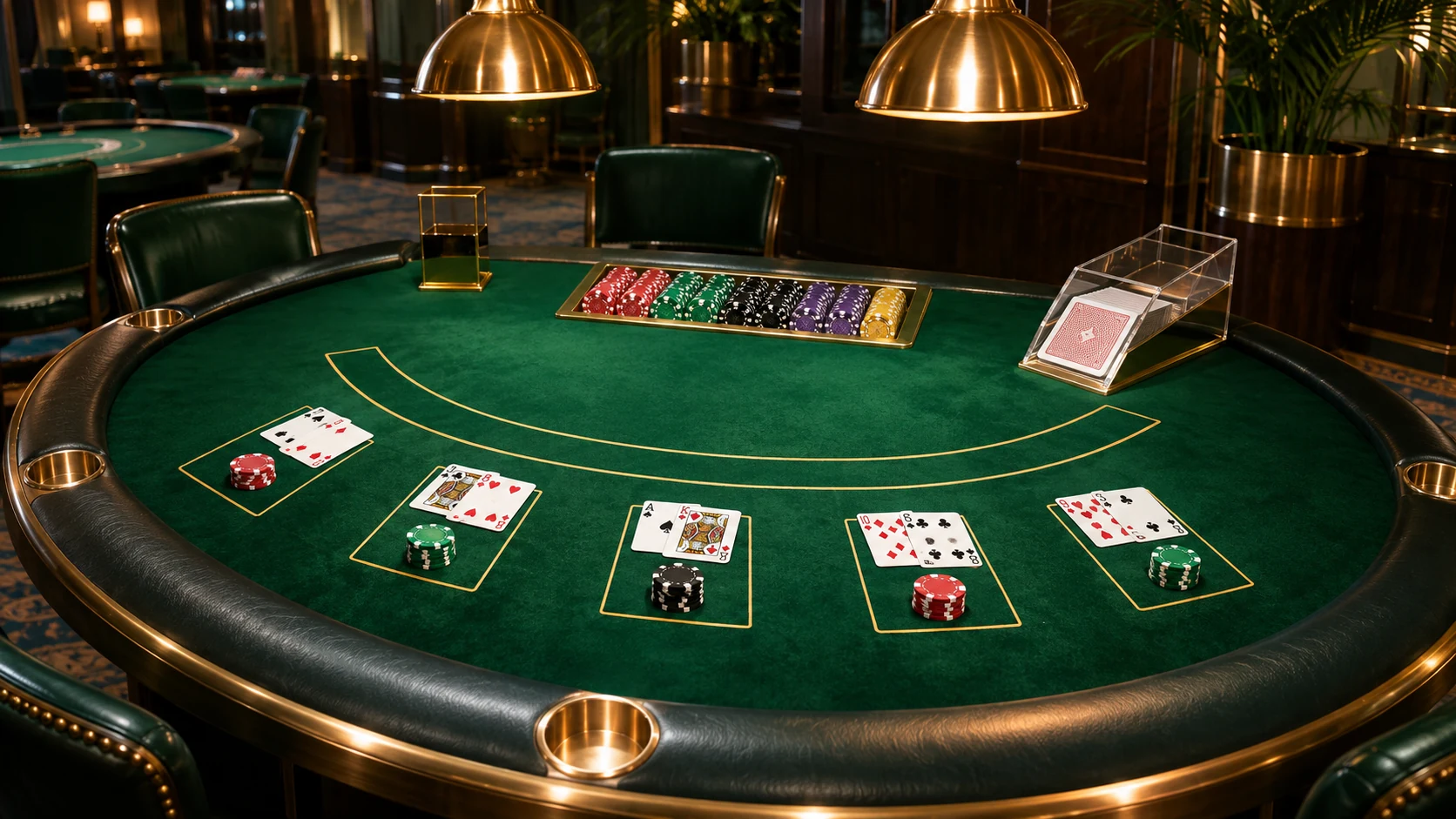
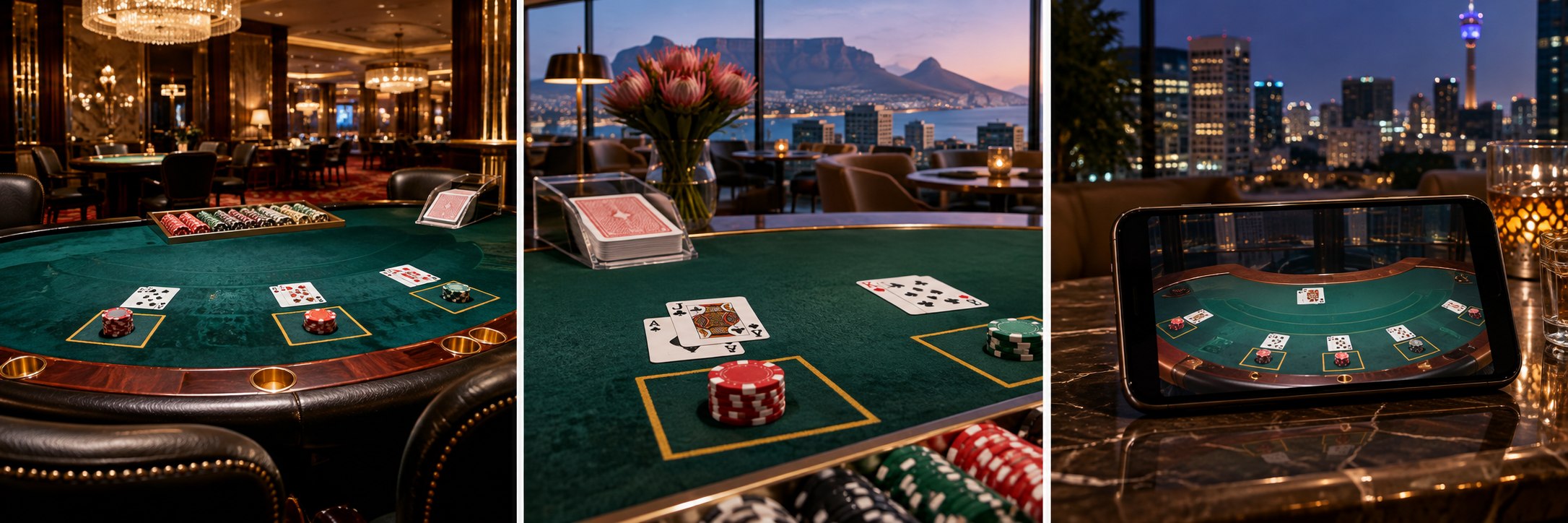
At a live blackjack table, a dealer handles physical cards while a camera streams the round to players using on-screen controls. The objective is familiar: beat the dealer's total without exceeding 21. The video may look like a casino floor, but the bets and decisions pass through software.
In South Africa, the distinction that matters first is legal. The National Gambling Board (NGB) (https://www.ngb.org.za/faqs/) says interactive online casino gambling is unlawful under the National Gambling Act. Online betting through a licensed local bookmaker operates under a different permission, limited to authorised products. A bookmaker's live blackjack listing is not proof that the game is permitted. Blackjack at a licensed land-based casino is a separate matter.
Live Blackjack at a glance
| Feature | What it means |
|---|---|
| Game category | Live casino table game; the player competes against the dealer, not other players. |
| Cards and dealer | Physical cards dealt by a real person in a studio or casino, with live video and on-screen controls. |
| Typical format | Seven seated positions; certain Infinite Blackjack variants support unlimited participants. |
| Main decisions | Hit, Stand, Double Down and Split; Insurance and Surrender depend on the rules. |
| Blackjack payout | Often 3:2 on classic tables, but the displayed paytable takes precedence. |
| Betting currency | South African rand (ZAR/R) may appear on local-facing interfaces; limits change by table and operator. |
| South African online status | Interactive online casino games are not authorised under the NGB's published interpretation of current law. |
Is Live Blackjack legal in South Africa?
The NGB treats online Live Blackjack as prohibited interactive casino gambling in South Africa. Section 11 of the National Gambling Act 7 of 2004 addresses unauthorised interactive gaming. The distinction is between internet casino games and licensed online sports or horse-racing betting. Streaming the dealer from another country does not remove the South African restriction.
Some betting sites present streamed casino games as fixed-odds bets offered under bookmaker licences. The distinction is contested. 2026 legal commentary (https://www.golegal.co.za/online-gambling-illegal/) discusses the Supreme Court of Appeal's Portapa ruling against that argument in a streamed-roulette case; the judgment was not an authorisation of blackjack. A provincial bookmaker licence or offshore casino licence does not automatically cover an online blackjack table. The NGB's Verified Operators register (https://www.ngb.org.za/verified-operators/) can identify a licensed business, but the permitted activity must also be checked.
Adults aged 18 and over can play at suitably licensed land-based casinos. Casino-floor terminals are another format: Sun International's Stadium Gaming (https://www.suninternational.com/gaming/stadium-games) streams a real dealer to equipment inside the licensed venue, not to an account at home. GrandWest, Time Square, Sun City and Sibaya have been named for stadium gaming. Individual venues determine which tables and rules are available.
A rand balance, a foreign licence or a “100% legal SA live blackjack” label cannot establish South African authorisation. Betway, SunBet and Hollywoodbets are betting brands; Evolution and Pragmatic Play supply games. The distinction between an operator and a game supplier is useful, but neither brand name proves that a specific internet casino game is legal.
How a live dealer blackjack round works
Cameras cover the dealer, shoe and table. Card-recognition technology links each physical card to the on-screen display; software accepts decisions and settles bets. Players may also have a text-chat option. The ordinary blackjack result comes from the cards, although multiplier variants can add a separate random-number-generator (RNG) feature.
- Table selection: The lobby identifies the game variant, available seats, minimum and maximum bets, currency, and rules or paytable.
- Betting window: Digital chips are placed before the countdown closes. Main wagers and optional side bets can have different limits.
- Initial deal: Players receive two cards; the dealer's upcard is visible. The second dealer card may be face down, or dealt later, under the chosen game's rules.
- Player decisions: Active seats use Hit, Stand, Double Down or Split within a timer. The system may apply a default action if time expires.
- Dealer hand and settlement: The dealer completes the hand under fixed rules, then main wagers and side bets are settled directly.
A shoe often holds six or eight 52-card decks. The actual count, cut-card position and reshuffle procedure come from the table rules. Seeing the cards on video does not remove the house edge or prevent a stream from failing.
Live Blackjack rules, card values and payouts
Number cards count from 2 to 10; Jacks, Queens and Kings count as 10. An Ace can be worth 1 or 11. A hand using an Ace as 11 is soft, because it can fall back to 1 without busting. Otherwise the hand is hard.
A natural blackjack is an Ace and a ten-value card dealt first. It beats a 21 assembled from three or more cards. When both sides have a natural blackjack, standard rules call the tie a push and return the original wager. A total above 21 is a bust.
| Result or action | Standard meaning | R100 main-bet illustration |
|---|---|---|
| Ordinary win | Pays 1:1 | R100 profit; R200 returned including stake |
| Natural blackjack at 3:2 | Pays 1.5 times the original bet as profit | R150 profit; R250 returned |
| Natural blackjack at 6:5 | Pays 1.2 times the original bet as profit | R120 profit; R220 returned |
| Push | Tied qualifying hands | Original R100 returned, no profit |
| Insurance | Separate wager commonly paying 2:1 if the dealer has blackjack | R50 insurance stake yields R100 insurance profit if it wins |
On a R100 stake, a natural blackjack pays R150 profit at 3:2 but only R120 at 6:5. The R30 difference applies every time that outcome wins. Under otherwise comparable rules, switching from 3:2 to 6:5 increases the house edge by about 1.39 percentage points; see the blackjack rule-variation calculations (https://wizardofodds.com/games/blackjack/basics/).
Which decisions can the player make?
- Hit
- Take another card. A total above 21 loses the hand.
- Stand
- Keep the current total and end the player's turn.
- Double Down
- Increase the original wager, commonly by an equal amount, and receive exactly one additional card.
- Split
- Turn two equal-value starting cards into separate hands with a second wager. Split Aces often receive only one additional card each.
- Surrender
- Forfeit part of the original stake to end the hand early, only where the table expressly allows it.
- Insurance
- Place a separate bet when the dealer shows an Ace. Its 2:1 payout does not make it a reliable protection against losing the original hand.
Dealers follow house rules: stand on soft 17 (S17) or hit soft 17 (H17). The rules also specify Double After Split (DAS), re-splits and any extra exposure in a European no-hole-card game when the dealer later reveals blackjack. Those details affect basic strategy.
Live Blackjack variants: classic, infinite, speed and multiplier tables
“VIP” usually refers to higher stakes, not a better return to player (RTP). Speed, seating, multipliers and special rules vary across named games. Compare the fee, paytable and dealer rules of the actual edition rather than relying on its title.
| Variant | Distinguishing feature | Rule or cost to check |
|---|---|---|
| Classic Live Blackjack | Real dealer, commonly seven seats and optional Bet Behind | Blackjack payout, soft 17 rule, double and split restrictions |
| Speed Blackjack | Designed to reduce pauses between decisions and rounds | Time limits and the total number of hands played per session |
| Infinite Blackjack | Unlimited participants share an initial hand, then make individual decisions | Special rules such as Six Card Charlie; available side bets |
| Lightning Blackjack | Randomly assigned multipliers tied to winning hands and later rounds | Evolution specifies a 100% Lightning fee on each initial bet |
| ONE Blackjack | Pragmatic Play Live uses a single shared position for unlimited players making individual decisions | Rules for Six Card Charlie and optional Crazy 7 or Bust Bonus wagers |
| Free Bet Blackjack | Qualifying doubles and splits are funded by a free-bet mechanic | Compensating dealer rules, including the treatment of a dealer 22 |
| Power Blackjack | Multiple double-down levels and a modified card composition | Evolution removes ranks 9 and 10, while face cards remain |
| Blackjack Party | Studio entertainment and a more social presentation | Underlying payout rules rather than the presentation style |
| VIP / Salon Privé Blackjack | Premium tables, higher bet limits and enhanced service | Minimum stake, maximum stake and table-specific rules |
Evolution supplies Infinite Blackjack, Lightning Blackjack, Free Bet Blackjack, Power Blackjack, Salon Privé and Bet Stacker Blackjack, which includes an additional-fee feature. Ezugi belongs to the Evolution group. Pragmatic Play Live offers conventional dealer blackjack; Playtech is linked with Quantum Blackjack. Catalogues also list All Bets Blackjack and Blackjack Lobby. These names identify products or interfaces, not a shared set of rules.
First Person Blackjack from Evolution is animated and RNG-based, with no live dealer. Pragmatic Play's Blackjack X was introduced as a dealerless game too. Studio-style graphics are not evidence of physical cards or a person dealing them.
Perfect Pairs, 21+3 and other side bets
A side bet settles directly of the main hand. Large advertised prizes can disguise a lower theoretical return than the base blackjack wager. Even when the side bet loses, the main hand continues under its own rules.
- Perfect Pairs: Wins if the first two player cards form a pair. Mixed Pair, Coloured Pair and Perfect Pair describe increasingly specific matches; a perfect pair requires identical rank and suit across different decks.
- 21+3: Combines the player's first two cards with the dealer's upcard to make poker-style combinations such as a Flush, Straight, Three of a Kind, Straight Flush or Suited Trips.
- Any Pair / Player Pair / Dealer Pair: Pair-based bets evaluated using the relevant two-card hand.
- Crazy 7 / Bust Bonus: ONE Blackjack includes a bet on three sevens among the first three player cards and a separate bet on the dealer busting.
- Hot 3 / Top 3: Three-card combination bets with their own winning categories and paytables.
- Bust It: A separate wager on the dealer exceeding 21, sometimes with payouts linked to the number of cards used.
One published eight-deck Live Blackjack ruleset (https://help.betmgm.co.uk/hc/en-gb/articles/12186050178450-Live-Blackjack) publishes 99.28% RTP for the base game, 95.90% for Perfect Pairs and 96.30% for 21+3. The figures belong to that paytable; another table may differ. Side bets increase total money staked in the round.
Bet Behind and Six Card Charlie
With Bet Behind, an additional participant backs a seated player's hand while that player makes the main Hit and Stand decisions. Insurance, doubles and splits may be treated differently in the interface. A player's recent wins do not improve the next deal.
Six Card Charlie, offered in certain Infinite formats, rewards a six-card hand totalling no more than 21 under the game's rules. Ordinary seven-seat blackjack does not automatically include it.
RTP, house edge and basic strategy
Return to player (RTP) describes the theoretical long-run share of stakes paid back, not a session result. At 99.28% RTP, the corresponding house edge is 0.72% under the stated assumptions. Applied to R10,000 of cumulative wagers, that edge gives R72 in expected loss; actual outcomes can differ sharply because of variance.
Basic strategy uses the player's cards and the dealer's upcard to select Hit, Stand, Double or Split by expected value. Match any chart to the number of decks, S17 or H17, surrender and Double After Split rules. American hole-card advice cannot always be carried over to European no-hole-card tables.
The dealer's upcard changes the calculation even when the player's total stays the same:
- Soft 18 (Ace + 7): Standing automatically because the total is 18 overlooks that the dealer's upcard can change the optimal play. Against a dealer 9, 10 or Ace, hitting is the usual basic-strategy choice in standard multi-deck games.
- Hard 16 versus a dealer 10: An apparently safe stand can still have worse expected value than the chart's recommended action; surrender rules can change the choice.
- Splitting 8s: Two separate starting hands can have a better expectation than keeping a hard 16, but the exact value reflects the table's splitting and dealer rules.
Card counting faces practical limits in live multi-deck shoes: cut cards, shuffles and short decision windows. Martingale and other systems that raise bets after losses do not change the house edge. They increase the amount exposed to the next hand.
A faster table can process more hands per hour. That increases the total sum wagered and, with it, the expected monetary cost at a given house edge. RTP is not the chance of winning a single hand.
What separates a suitable table from an expensive one?
A polished studio says nothing about the cost of a hand. Blackjack payouts, dealer rules, extra fees and stake sizes do. A single rule change can outweigh the appearance of the table.
| Check | Why it matters |
|---|---|
| 3:2 or 6:5 for blackjack | Affects the payout on a natural blackjack and materially changes the house edge. |
| S17 versus H17 | Dealer hitting soft 17 reduces player expected return under comparable rules. |
| Double After Split and surrender | Restrictions change which hands are worth doubling, splitting or surrendering. |
| Minimum and maximum stake | Check values in ZAR, including any separate side-bet limits and the extra exposure from splits or doubles. |
| Fees and special mechanics | Multiplier games may charge a distinct fee that is easy to miss beside the base stake. |
| Connection-loss policy | An interrupted stream may trigger an automatic action; settlement depends on the published game rules. |
| Licence and permitted product | The authorisation must cover the activity, not merely the brand or its sports-betting division. |
A “welcome bonus” or “free spins” promotion may exclude live blackjack from wagering requirements or count it at a reduced rate. FICA/KYC checks, Instant EFT, card payments and ZAR wallets may be familiar from South African betting platforms. None verifies permission to offer online casino blackjack.
Live Blackjack versus RNG blackjack and land-based tables
| Format | Cards and interaction | Main trade-off |
|---|---|---|
| Online Live Blackjack | Physical cards, streamed real dealer, timed on-screen decisions | Studio atmosphere and visible deal, with streaming delays and South African legal restrictions |
| RNG / First Person Blackjack | Software-generated card outcome, animated interface, self-paced rounds | Less waiting, but no human dealer; online casino restrictions still apply in South Africa |
| Licensed land-based blackjack | Physical casino table and in-person dealer | Travel and venue hours, but play takes place within the authorised casino setting |
| On-premises stadium blackjack | Real dealer video shown on terminals inside licensed casino premises | Electronic interface without being an at-home online casino product |
The broader live casino catalogue contains roulette, baccarat, poker-style games and presenter-led products such as Crazy Time and MONOPOLY Live. They share video technology, not identical rules, odds or house edges.
Mobile play, streaming quality and interruptions
Phones, tablets and desktop browsers can display a live table over Wi-Fi, 4G or 5G. A clear picture matters less than a responsive betting control: video can lag while the decision timer keeps running. Long sessions also use mobile data.
If a connection fails after a wager is accepted, the round may continue without the player's input. Some games apply Auto-Stand when the timer expires; others specify different defaults. Round history, the transaction record and the game's published rules establish the settlement, not the last frozen video frame.
Dealer chat usually lets players type while the host replies on camera. A normal live stream does not give the dealer access to the player's camera or microphone. Video-enabled or optional-interaction products have separate privacy settings.
Stake sizes, bankroll exposure and responsible gambling
An R25 minimum does not cap a hand’s loss at R25: splits and doubles require extra stakes. R500 covers 20 original R25 bets before any additions, not 20 guaranteed rounds. The better exposure measure is total money staked.
Even sound blackjack decisions cannot predict the cards. Chasing losses, borrowing, repeated deposits or playing longer to recover money increase gambling harm. A money limit and a time limit offer clearer boundaries than betting progressions.
The National Responsible Gambling Programme offers free support. The NGB (https://www.ngb.org.za/stakeholder-information/national-responsible-gambling-programme/) explains counselling and self-exclusion. Gambling is for adults aged 18+.
Live Blackjack questions answered
Can South Africans legally play Live Blackjack online for real money?
No blanket approval exists for internet live blackjack under the NGB's published interpretation. A provincial sports-betting licence or ZAR payment option does not authorise an interactive casino game. Blackjack inside a licensed land-based casino is treated separately.
Are the dealer and cards real?
Yes, in live-dealer blackjack. A dealer handles physical cards and software relays the decisions. First Person Blackjack and Blackjack X do not have a live dealer.
Is Live Blackjack better than ordinary online blackjack?
Live blackjack provides a visible dealer and shoe; RNG blackjack produces software-generated outcomes at a different pace. Neither format has a built-in RTP advantage. Table rules and payouts decide the mathematics.
Does a 99% RTP mean I will get R99 back from every R100?
No. A 99% theoretical RTP describes long-run returns over many bets, not R99 owed on an individual R100 stake. A single session can finish with a loss or a win.
Can a blackjack strategy guarantee wins?
No. Basic strategy improves decisions but cannot select the cards. Insurance, side bets and progressive betting leave the house edge intact.
What happens when all seven seats are occupied?
Some classic tables have Bet Behind for wagers on an occupied seat. Infinite Blackjack instead gives unlimited participants their own decisions after the initial shared deal.
Are free Live Blackjack demos available?
Educational previews and free-play information may exist, subject to local restrictions. An RNG demo is not a live-dealer game, and free access says nothing about legal permission for real-money play in South Africa.
Where can blackjack with a real dealer be played legally in South Africa?
Licensed casino venues can host physical dealer tables or on-premises stadium terminals. The provincial authorisation and the available games need checking for that venue.